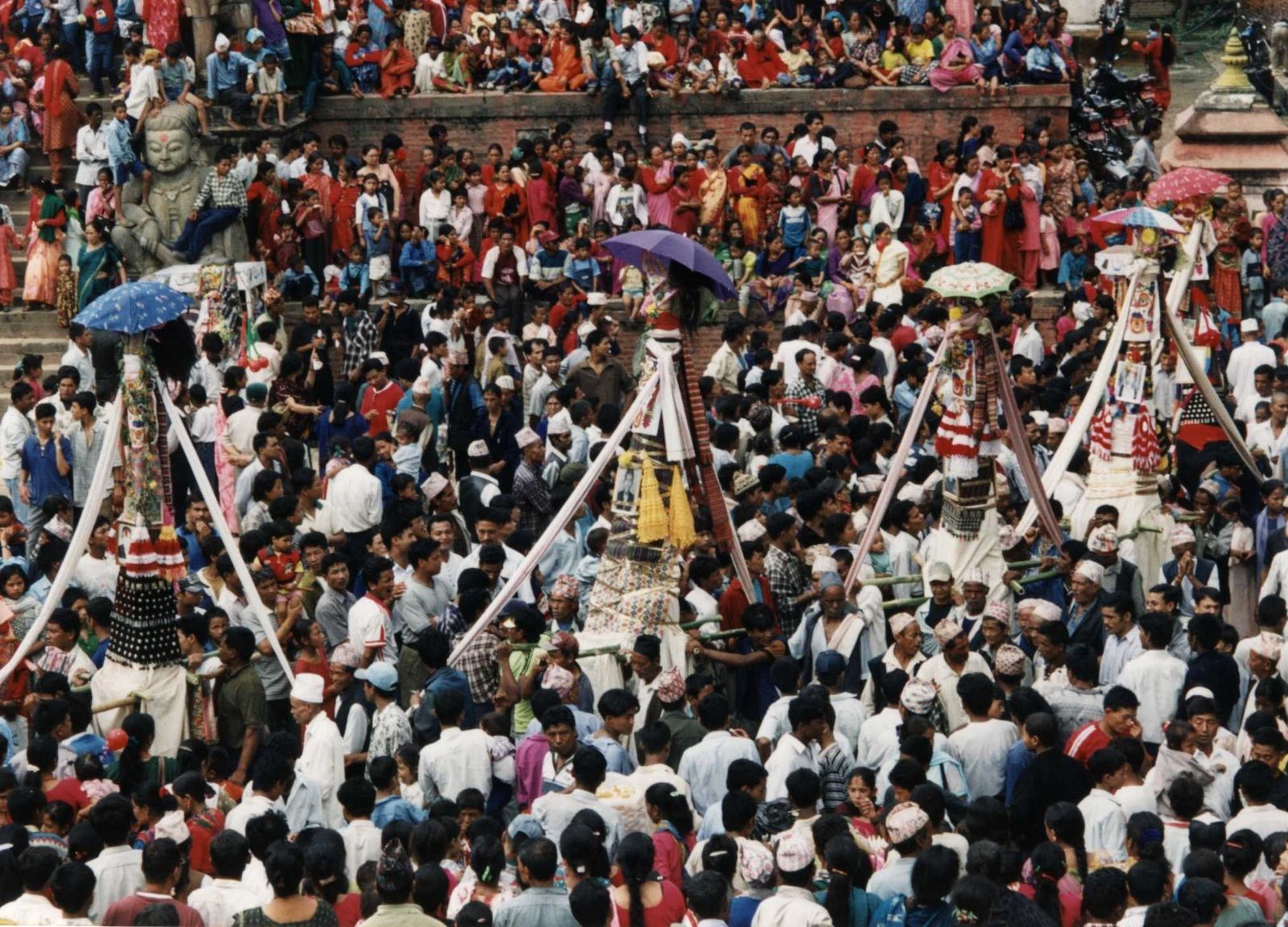
CELEBRATING GHAI JATRA

In this year’s Gai Jatra, I hope to experienced new things. I will first visit Basantapur and go to bhaktpaur to watch this Jatra. There were groups of people who were actively working to clean the streets and making people aware of recycling the waste products. In my opinion such programs are more effective to inform people about general issue like recycling in such festivals as many people come to participate and to watch festivals.
Gai Jatra is a festival celebrated by the Newar community every year since the malla period. We see newars celebrating this festival in different cities where there is strong pesence of newars. Now a days we see other community also particiapting in this festival. It is one of the most popular festivals of Nepal. This festival comes just a day after Janai Purnima and this year it is held on 29th of the Sarwan (aug 14). The festival commemorates the death of people during the span of a year. Gai Jatra is a healthy festival which enables the people to accept the reality of death and to prepare oneself for the life after death. The festival of cows is one of the most popular festivals of Nepal.
Every family who lost their member goes to participate in this festival. They bring children or some time adult also with resemblance of Radha Krishna or give those funny looks or resemblance of cow, yogi and other Hindu idol. Some family brings the real cow too.
In Kathmandu the festival is held around Basantapur, in Bhaktpaur around the hole Bhaktapur city and in Lalitpur they go around the Patan Durbar Square.


 hakali, Mahalaxmi and Dasha Avatara masked dances are staged in Kathmandu Durbar Square, near the Kumari Temple. The "Dasha Avatara" refers to the ten incarnations of Lord Vishnu who is one of the Hindu's Holy trinity. The excitement of the festival of Indra Jatra comes to an end on the last evening of the festival when the long wooden pole erected on the first day is lowered with religious ceremonies, animal sacrifices and ritual gestures.People of Kathamandu also celebrate indra jatra.The people of Kathmandu celebrate the religious festival of Indra Jatra remembering Lord Indra, the god of rain. Indra Jatra is also called Yandya in Newari culture. this This festival was started by Lichhavi king Gunkamadev in Kaligat Sambat 3822. In Nepalese culture Indra is a very important god.Indra Jatra begins every year from the day of the fortnight Dwadasi Bhadra month to Aswin Krishna Chaturdasi sthat is it is a eight day long festival. On the first day of Indra Jatra a pole known as Linga or Yasingh with a flag on the top is erected at Hanuman Dhoka area. This thirty-six feet long wooden pole is chosen with great care from the Nala forest in Kavre district east of Kathmandu. According to traditional beliefs, Indra had received this flag from Lord Vishnu for protection. It is said that Indra’s mother needed parijat, a type of flower, for some religious ritual so Indra disguised as a human being came to the earth to fetch them. But, he was recognised when he was to steal the flowers so the people caught him and tied him with ropes the statue of which is still worshipped in Maru Tole in Kathmandu. This image is also put on display with others in different parts of the city during Indra Jatra festival. Indra Jatra is a very interesting festival because for the whole week people enjoy various traditional dances and witness the chariot of Goddess Kumari, Lord Ganesh and Lord Bhairav being pulled through the older parts of the Kathmandu city. A day has been added to the original seven days of celebration and on that day known as Nanicha yaa the chariots are pulled through Naradevi, Nhyokha, Ason, Indrachwok and Hanuman Dhoka. This extra day of chariot pulling was introduced by king Jaya Prakash Malla in 1765 B.S. In Indra Chowk, the famous Akash Bhairava bust is displayed and it is decorated with flowers. This Akash Bhairava’s head is related to the Mahabharata story. Some believe it to be the head of the first Kirat King Yalamber. In Indra Chowk, every night different groups gather and sing bhajans and hymns.During Indra Jatra, there are a variety of performances including the dances of Sawa Bhakku Bhairav from Halchowk, Lakhes from Majipat, Devi Nach and Yeravat hathi (Pulukisi) from Naradevi, Mahakali and Kathi Maka Nach from Bhaktapur. All the dances take place around Hanuman Dhoka area. The Dasavatar or the ten incarnations of Lord Vishnu is also staged every night. The first day of the festival is also observed by the Newars as a day to remembe
 r the family members who passed away during the past year by offering small oil lamps along a traditional route covering all the parts of the oldcity. It is believed to have been started during the reign of Mahendra Malla.The Linga (Yasingh) is pulled down signalling the end of Indra Jatra festival. It is taken to the confluence of Bagmati and Bishnumati in Teku to be put to rest.. The end of the Indra Jatra festival heralds the beginning of Dashain and Tihar celebrated with great enthusiasm not only in the Kathmandu Valley but throughout the country.
  Deep below at the base of the Shivapuri Hill within the Kathmandu Valley on the northern end, lies the mystical Buddhanilkantha Temple, meaning “old blue-throat”, just 9 km away from the main city. It is at this location that you will find one of the three images of the deity Lord Vishnu or in full Vishnu (Narayan) Jalasayana which is regarded by the local people as the principal deity. It is with the sacredness of this particular god that a deep-seated belief was created by King Pratap Malla through a prophetic dream. It was his strong belief and fear that should the King of Nepal visit the Buddhanilkantha temple, death would be imminent upon his departure. The two other images of the deity which were carved during the same time lie at two particular destinations: the Balaju Gardens where public viewing can take place and the beautiful Royal Palace in Kathmandu. It is here at Budhanilkantha Temple, however, that public viewing is not permitted. The Deity of Lord Vishnu lies prominently at 5 meters in length inside a tank 13 meters long giving the impression of floating. It is thought that the Deity is approximately 1500 years old and is believed to have been sculpted during the Licchavi period, around about the 7th or 8th century. A fascinating feature of the Lord Vishnu Deity is his large frame carved out of a single block of stone, black in nature and foreign to the valley planes. When described he embodies many fascinating features and all symbolic in their own right. But it is through the four hands that you will find four symbols of Vishnu which are the: chakra or disc, conch-shell, lotus flower and the club. His legs are crossed with his sleeping body resting on the coils of Ananta: the cosmic serpent and his 11 hooded heads. It is alleged in times past that a farmer and his wife occupied a farm in this area and while cultivating the land they struck the Deity and immediately afterwards blood began to filter from the ground and thus the lost deity of Budhanilkantha was recovered and placed in its rightful position. It is a common practice for the Hindus to walk down to Vishnu’s feet to touch them but it is forbidden for foreign visitors to do the same. Budhanilkantha has become the site on which Haribondhini Ekadashi takes place during lat
 e October or the beginning of November. It is the principle festival for the year in celebration of the awakening of Lord Vishnu from his long sleep; a notable time for thousands of people. Today the formidable temple of Budhanilkantha, interestingly enough, even provides a guest house, unthought-of till now.This is famous temple of nepal.

 ed the Narayani and goes on to meet the Ganges. The Karnali river system in western Nepal consists of the Humla Karnali, Mugu Karnali, Seti and Bheri rivers and is the longest river system in the country. The Humla Karnali, which rises in Tibet, is the main tributary. After entering India, this river assumes the name Gogra.